 UC Berkeley
There are many reasons why natural selection may not produce a “perfectly-engineered” trait. For example, you might imagine that cheetahs could catch more prey and produce more offspring if they could run just a little faster. Here are a few reasons why natural selection might not produce perfection or faster cheetahs:
- Lack of necessary genetic variation
Selection can only operate on the available genetic variation. A cheetah might run faster if it had “faster” alleles — but if faster alleles are not in the population from mutation or gene flow, evolution in this direction will not happen.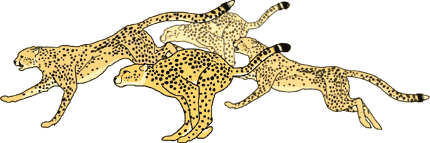
- Constraints due to history
Perhaps a different arrangement of leg muscles and bones would produce cheetahs that run faster — however, the basic body form of mammals is already laid out in their genes and development in such a mutually constrained way, that it is unlikely to be altered. There really may be “no way to get there from here.” - Trade-offs
Changing one feature for the better might change another for the worse. Perhaps faster alleles exist in the cheetah population — but there is a trade-off associated with them: the alleles produce cheetahs with longer legs (and hence more speed), but these long legs are hazardously delicate. Although longer limb bones increase stride, their chances of failing due to bending loads increases as well. In this case, perhaps no net increase in fitness would result from the faster alleles.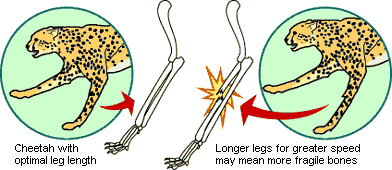
So natural selection may not produce perfection, but you’d at least expect it to get rid of obviously deleterious genes, wouldn’t you? Maybe not….