 UC Berkeley
Does evolution occur in rapid bursts or gradually? This question is difficult to answer because we can’t replay the past with a stopwatch in hand. However, we can try to figure out what patterns we’d expect to observe in the fossil record if evolution did happen in bursts, or if evolution happened gradually. Then we can check these predictions against what we observe.
What should we observe in the fossil record if evolution is slow and steady?
If evolution is slow and steady, we’d expect to see the entire transition, from ancestor to descendant, displayed as transitional forms over a long period of time in the fossil record.
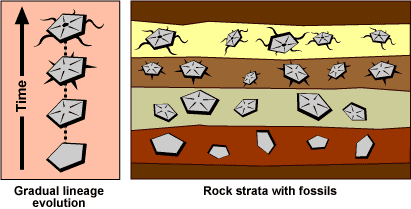
In the above example, the preservation of many transitional forms, through layers representing a length of time, gives a complete record of slow and steady evolution.
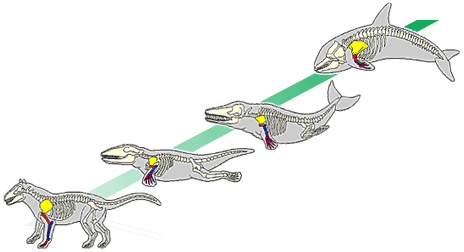
In fact, we see many examples of transitional forms in the fossil record. For example, to the right we show just a few steps in the evolution of whales from land-dwelling mammals, highlighting the transition of the walking forelimb to the flipper.
What would we observe in the fossil record if evolution happens in “quick” jumps (perhaps fewer than 100,000 years for significant change)?
If evolution happens in “quick” jumps, we’d expect to see big changes happen quickly in the fossil record, with little transition between ancestor and descendant.
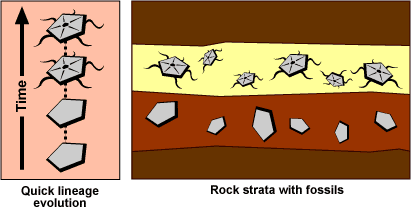
In the above example, we see the descendant preserved in a layer directly after the ancestor, showing a big change in a short time, with no transitional forms.
When evolution is rapid, transitional forms may not be preserved, even if fossils are laid down at regular intervals. We see many examples of this “quick” jumps pattern in the fossil record.
Does a jump in the fossil record necessarily mean that evolution has happened in a “quick” jump?
We expect to see a jump in the fossil record if evolution has occurred as a “quick” jump, but a jump in the fossil record can also be explained by irregular fossil preservation.

This possibility can make it difficult to conclude that evolution has happened rapidly.
We observe examples of both slow, steady change and rapid, periodic change in the fossil record. Both happen. But scientists are trying to determine which pace is more typical of evolution and how each sort of evolutionary change happens.
Read more about competing hypotheses on the pace of evolution or delve into one of these ideas, punctuated equilibrium.
Learn more about transitional forms in context: What has the head of a crocodile and the gills of a fish?, a news brief with discussion questions.
Learn more about transitional features in Understanding macroevolution through evograms, a module exploring five examples of major evolutionary transitions in the fossil record.
Learn more about the pace of evolution in context: Hotspots for evolution, a news brief with discussion questions.
Teach your students about transitional forms: Hominid cranium comparison, a classroom activity for grades 9-12.
Find additional lessons, activities, videos, and articles that focus on transitional forms.